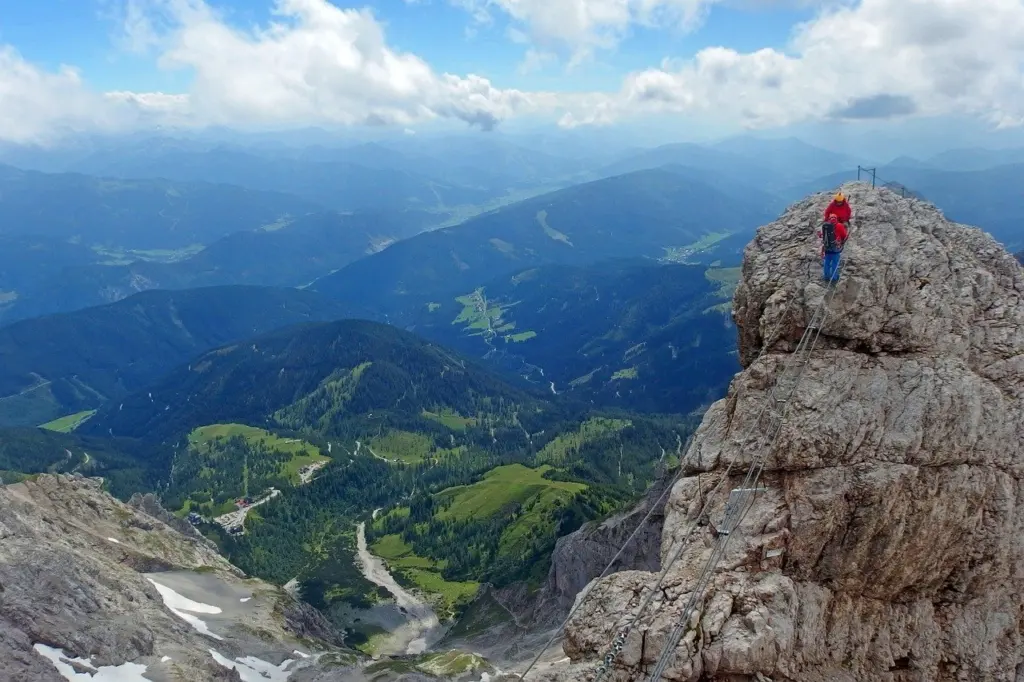
Picture a cable trail that looks like a hike. The Telluride via ferrata is a technical, exposed climb on fixed cables and rungs, and both the Telluride Mountain Club and Visit Telluride strongly recommend hiring a local guide.
Fixed-cable routes are one of the more specialised types of adventure travel, and this one has quirks that catch people out. For the general idea behind the format, see Via Ferrata Explained: What It Means, How It Works, and How To Try One Safely. The sections below separate what the route actually involves from what visitors tend to assume.
What the Telluride via ferrata is and where it goes
The Telluride via ferrata is a cliff route in Colorado where climbers clip into fixed steel cable and iron rungs. The Telluride Mountain Club places it at the east end of the box canyon, on the south-facing wall below Ajax Peak. One hiking blog defines a via ferrata as steel rungs and cables attached to the side of a cliff that you hook up to. The same blog describes this outing as running east to west, covering about 2-3 miles and taking about 4-5 hours.
The vertical element is modest on paper but sustained in practice. Another trip report gives the elevation gain as 859 feet, with a maximum elevation of 10,094 feet. Exposure is the bigger story. Visit Telluride says that at its most intense, you are suspended on a small iron foothold by a harness at about 500 feet above the ground.
That combination of a short distance, a half-day time commitment and serious exposure is why the route is better treated as a climb than as a scenic walk with a handrail. The next section sets the common assumptions against what the route actually involves.
Assumptions that catch climbers out
Most misjudgements about this route come from its hiker-like sections, which make it look more casual than it is. The table sets four common assumptions against the route’s actual conditions.
| Common assumption | What the route involves | Planning use |
|---|---|---|
| “It is basically a hike.” | Technical climbing abilities and gear are required despite the hiker-like sections, with exposure of up to about 500 feet above the ground at the most intense section. | Practise clipping and climbing movement before you arrive, and do not rely on hiking fitness alone. |
| “The cable runs the whole way.” | The fixed cable is not continuous, and some exposed sections cannot be clipped. | Expect stretches where you rely on your own climbing movement; this is where a guide’s judgement helps most. |
| “I can bail out if it goes wrong.” | There are no options for escape off the route once you are on it. | Commit only with a settled weather window, enough daylight and energy to finish. |
| “It suits everyone in the group.” | The route is not appropriate for small children, very short adults, or people who do not enjoy heights. | Settle who is genuinely suited before booking, not at the base of the wall. |
These points come from the Telluride Mountain Club’s route page and Visit Telluride’s activity page.
The most important row for decision-making is the third. On a conventional hike, turning around is the default answer to bad weather, fatigue or nerves. Here the lack of escape options means the decision to go has to be made on the ground, with the day’s forecast and your group’s real ability in mind.
Guided or self-guided: a decision aid
You do not need to treat a guide as a rule, but you should treat one as the default. The Telluride Mountain Club says it highly recommends hiring a local guide for a more enjoyable, safe and less stressful experience. Visit Telluride makes the same recommendation and lists four guide services on its activity page.
A guide matters more here than on many fixed-cable routes because of the features above: gaps in the cable, no escape and a technical skill requirement. A guide also removes the gear question, which is a real obstacle for visitors, as the gear section below explains.
Choose a guide if
- You have not clipped into a cable route before. The route requires technical climbing abilities, and the unclippable sections are not the place to learn.
- You are travelling without your own kit. Hiring a guide avoids having to source a harness, lanyard and locking carabiners elsewhere.
- Your party is mixed in confidence. With no way off the wall, one nervous member can set the pace for everyone, and a guide can manage that.
- You want the day to feel less stressful. That is the club’s own stated reason for recommending a guide.
Self-guided only if
- You already own and trust the full kit. That means a dynamic lanyard, not an improvised tether.
- You are comfortable moving on exposed ground without a clip-in. Some sections cannot be clipped, so cable skills alone are not enough.
- You can judge weather and rockfall conditions yourself. The season section explains why this matters.
- You can commit to a half-day without a bail-out. A hiking blog describes a self-guided outing of about 4-5 hours, so the day needs padding for slower members.
If you cannot tick every item in the second list, book a guide. The cost of a guide is small against the consequences of getting stuck on a route with no escape.
Gear and clipping
The Telluride Mountain Club’s minimum kit is a harness, a helmet, a shock-absorbing via ferrata lanyard, at least three locking carabiners, hiking shoes, a snack and water. The club also advises bringing a headlamp if there is any chance of being up there in the dark.
The lanyard is the item people most often get wrong, so it deserves attention before the rest of the kit.
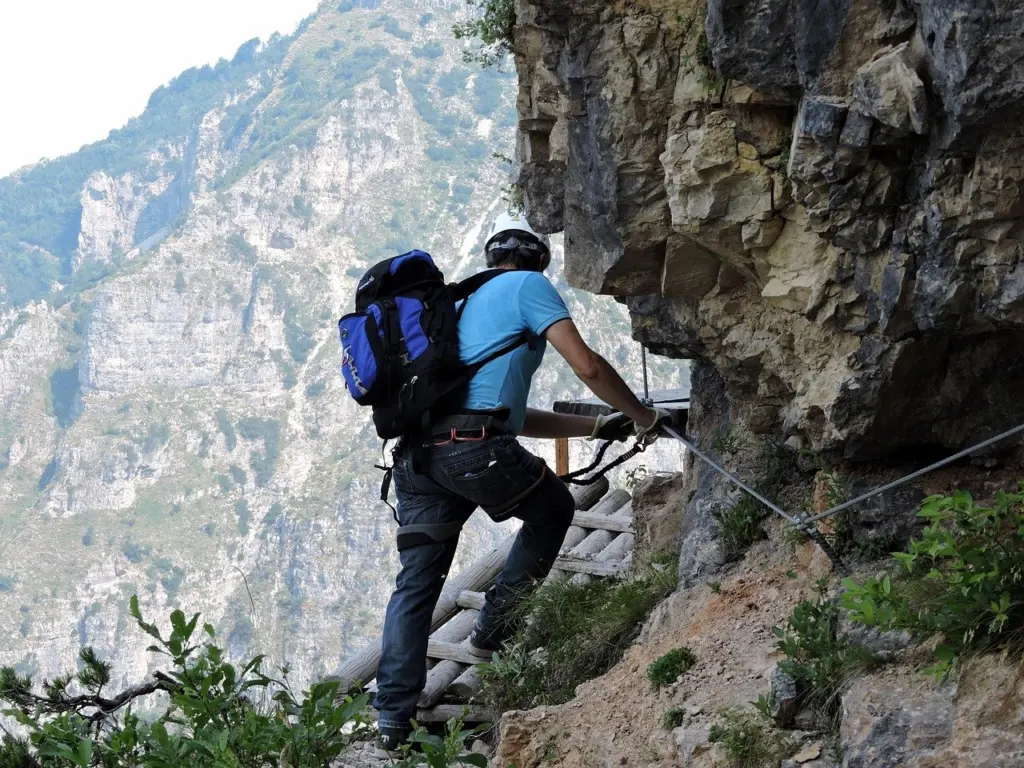
- Use a dynamic lanyard. The club calls a dynamic via ferrata lanyard the safest method of connecting yourself to the route’s fixed gear.
- Avoid static tethers and daisy chains. The club warns that this type of tether system can fail under much smaller forces than thought. A cheap sling is not a substitute.
- Keep two points of connection. The club says to always have two points of connection between you and the cable when that is an option.
- Move one carabiner at a time. A trip report on the route says both carabiners should always be clipped into the cable or iron rungs, so unclip one, move it past the obstacle, re-clip it, then move the other.
The helmet has a second job beyond falls. Rock can drop from above the route, a risk that rises in wet weather, as covered in the next section. Hiking shoes, rather than sandals or smooth-soled trainers, suit the iron rungs and the walk between sections.
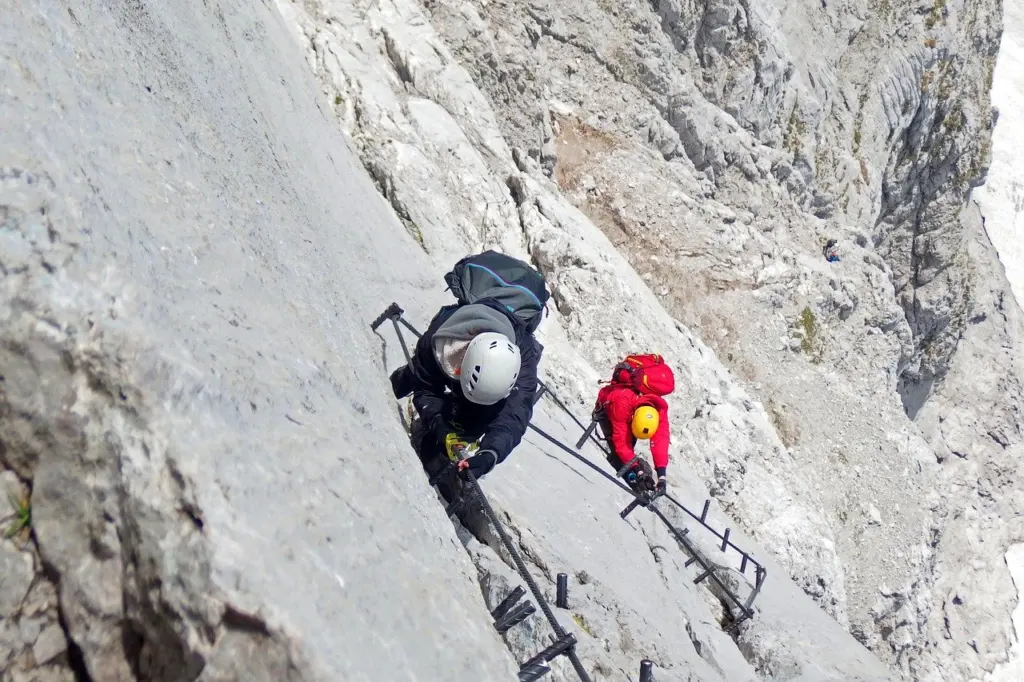
Season, weather and timing
Spring, summer and fall are the best times of year, according to the Telluride Mountain Club. The club frames timing by season and conditions rather than fixed calendar dates, so the practical question is which part of that window suits your group.
- Spring needs extra care. The club warns that snow can remain above the route, and rain, snow and hail increase natural rockfall from above. A helmet is not a reason to go when conditions are marginal.
- Summer is not automatically best. Telluride typically has rain in the afternoons from early July through mid-August. With no escape from the route, that points to an early start and finishing before the weather turns.
- Early fall is a strong choice. A trip report notes that the route stays shaded in the morning, making early fall an ideal time to go.
If you are booking a guide, ask the operator how current snow and recent rain are affecting the route before you commit to a date. If the forecast shows afternoon rain, move to the earliest start available or pick a different day rather than shortening the plan on the wall.
Frequently asked questions
| Question | Answer |
|---|---|
| How hard is the Telluride via ferrata? | A trip report rates it 2B on the Italian Via Ferrata Rating Scale, which it describes as moderately difficult with serious exposure. |
| Can I rent via ferrata gear in Telluride? | One hiking blog reports that no places in Telluride rent gear for the route, and that its authors rented in Ouray for $45 per person. Hiring a guide is the simpler way around the problem. |
| Do I need a headlamp? | Yes, if there is any chance of finishing in the dark, according to the Telluride Mountain Club. A slow group or a late start is enough reason to carry one. |
| How far is the walk to the route? | From the bottom parking area near the mine settling ponds, the club gives about 0.5 mile to the lower trailhead and 1.75 miles to the upper trailhead, as described on its route page. |