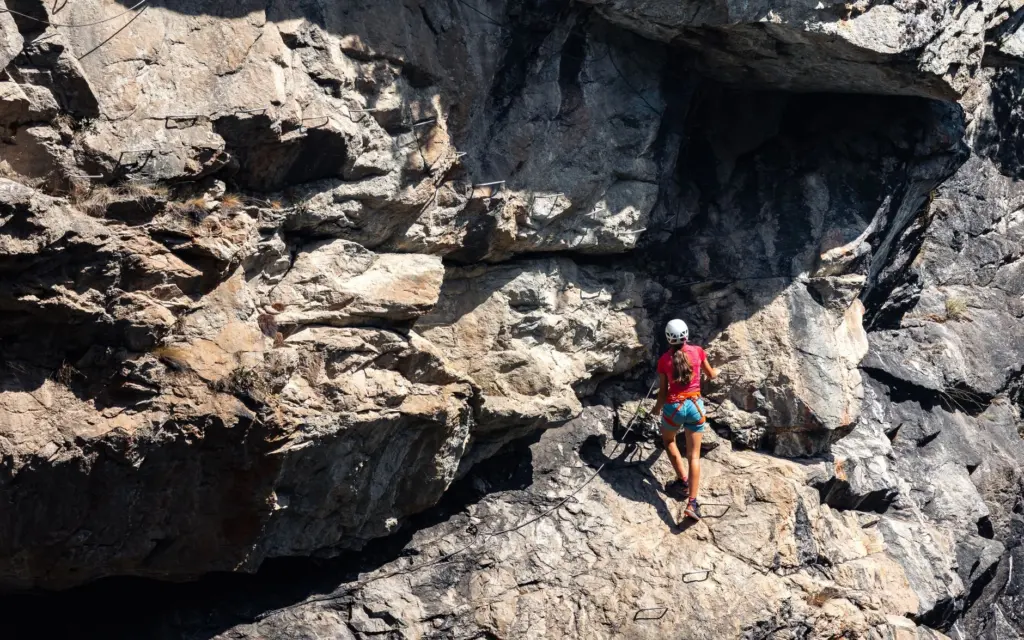
Picture a steep rock face with a steel cable running up it. The via ferrata meaning is “iron way”: a cabled route where you clip in and climb. Beginners can try one, provided they use the lanyard correctly and pick conditions carefully.
Via ferrata sits between hiking and roped climbing, and it is one of the more accessible entries in our guide to the types of adventure travel. The sections below separate what the term means from the myths that cause trouble, then explain the cable and lanyard system and the gear it needs.
What via ferrata means
A via ferrata is a traversing route along rock or very steep terrain, and the term roughly translates to “Iron Way”. The name describes the route itself: steel cabling and metal rungs and rails embedded into the mountain give you something solid to hold, stand on and clip to. Telluride Adventures describes the result as a cross between scrambling and climbing.
The practical meaning is that the mountain has been equipped in advance. You do not place your own protection or lead a pitch. You move along fixed hardware and stay attached to the cable with your own gear. That is why the activity suits people who want vertical exposure without a rope-climbing background, and why the gear and clipping habits matter so much.
Four common misunderstandings
Most first-timer mistakes come from a handful of assumptions about what the fixed hardware does. The table sets each one against what the guidance actually says.
| Common assumption | What is actually true | What to do |
|---|---|---|
| “It’s basically a hike on a ladder.” | Falling while climbing a via ferrata can be very painful and dangerous. | Treat it as a climbing activity and use full protective gear from the first step. |
| “The cable will stop me wherever I slip.” | The lanyard’s carabiners catch behind the last anchor below the climber, and a fall near the top of a wire runs the length of that wire. | Know where the next anchor is and keep your clip point close ahead. |
| “You must already be a rope climber.” | Guidance is to bring an experienced rope climber when the route is difficult or the group has little experience. | Match the route grade to your group and consider a guide for harder routes. |
| “A harness is all the protection I need.” | Climbers also wear a helmet, and the lanyard system includes a shock absorber with a brake. | Check that every item is present and fitted before leaving the ground. |
The figures and guidance above come from Ferrata Guide and Telluride Adventures.
The grading scale is the first filter against the third misunderstanding. Routes are graded by difficulty, and the difficult ones are where an experienced rope climber becomes a real advantage. Read the grade before you book, not after you arrive at the base.
Where the idea came from
Via ferrata courses have been around since the early 19th century and originated in Italy. Accounts of the very first route differ: Ferrata Guide dates the first real ferrata to 1843 on the Hoher Dachstein peak in Austria.
The same guide explains why so many routes sit on historic ground. Many of the routes used today are ancient military routes that made it easier for soldiers to move around mountain peaks. In the Dolomites, soldiers built ladders, mined galleries and tunnels while guarding the borders during the First World War. That history explains why modern routes can link ridges and passes that would otherwise demand technical climbing, and why the Dolomites remain the reference point for the activity.
How the cable and lanyard system works
The cable and anchors
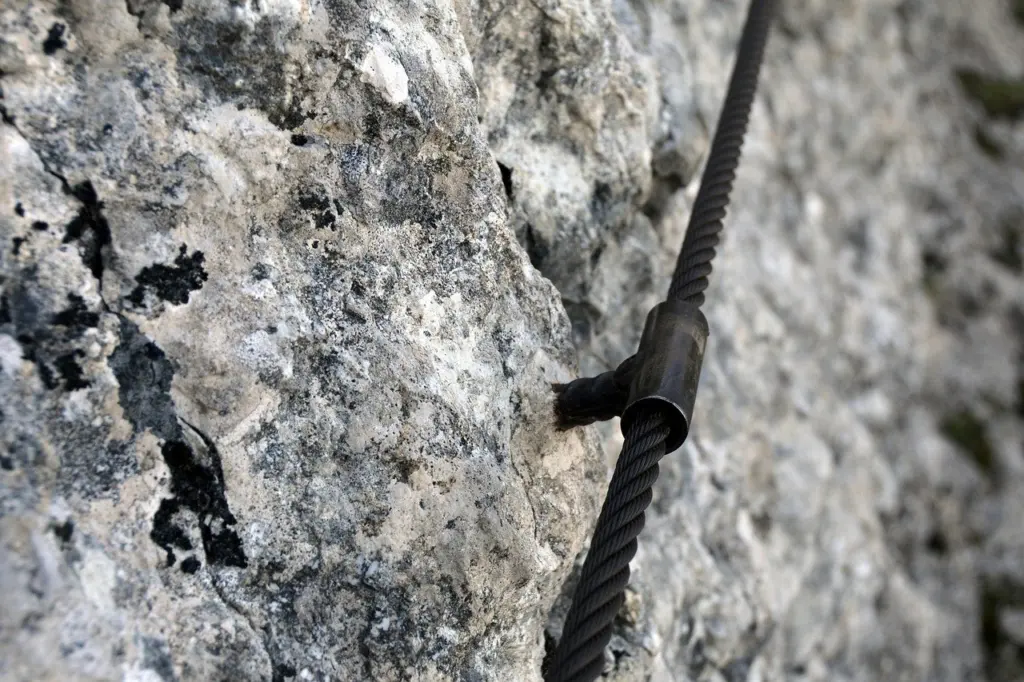
On a ferrata the climber is secured to a steel rope that is anchored in the rock at intervals of varying length, according to Ferrata Guide. The Cambridge Dictionary gives a typical figure for modern routes: the cable is fixed to the rock every 3 to 10 m. That spacing is the key to the system, because each anchor is a point where a falling climber can be stopped.
The lanyard and carabiners
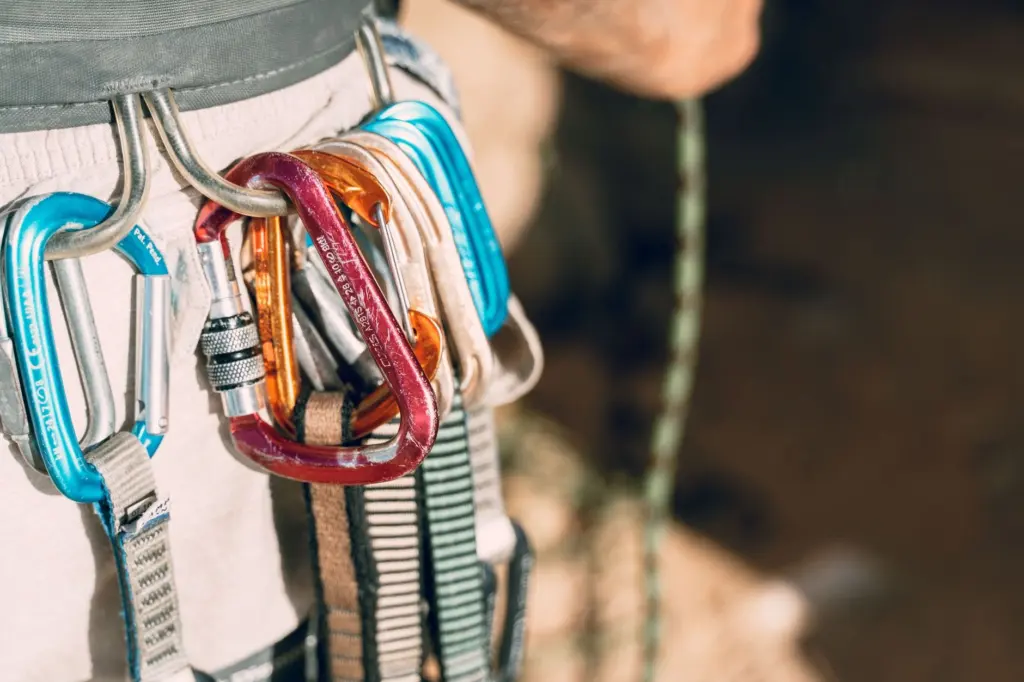
Your link to the cable is a shock absorber made up of two elastic lanyards, carabiners and a ripp’n’stop brake, as Ferrata Guide describes it. In a fall, the carabiners get stuck behind the last anchor below the climber, and the absorber slows the stop. Two lanyards matter because the rule from Telluride Adventures is that you have one carabiner attached to the wire at all times. In practice that means passing each anchor one carabiner at a time.
Clipping habits that limit a fall
- Clip forward. Clipping in as far forward on the cable as you can helps break a fall early, according to Telluride Adventures.
- Respect the long wire. A fall near the top of a wire runs the full length of that wire before the kit engages, so slow down and stay deliberate on long, exposed sections.
- Never be unclipped. Keep one carabiner on the wire throughout, including during rests and photo stops.
Gear you need
The core kit is small, and each piece has a distinct job. Rental operators typically supply it for guided outings, but you should still check that each item is present and fitted.
- Helmet. Climbers wear a helmet as part of the standard kit, according to Ferrata Guide.
- Harness. Either a sit harness or a full-body harness is used. This is the attachment point for the lanyard.
- Lanyard system. Two elastic lanyards, carabiners and a ripp’n’stop brake on a shock absorber form the fall-protection link described above.
A harness with no lanyard, or a lanyard with no helmet, is an incomplete setup. Treat the three items as a single system rather than as optional extras.
Safety for first-timers
Beginners can do a via ferrata, and the conditions on that answer are the route, the weather and who is with you. Colorado Via Ferrata says its Colorado courses require no previous experience, which is an operator’s statement about its own routes rather than a rule for every route. Ferrata Guide takes a more cautious line for harder terrain: when a route is difficult or the group has little experience, take an experienced rope climber with the skills the route needs.
Weather changes the picture. Telluride Adventures notes that snow and ice may make footholds slippery, and Ferrata Guide advises avoiding wet routes if possible. If conditions look poor, postponing costs far less than climbing on slick rock.
For a worked example of a first route at altitude, see Telluride Via Ferrata: Your 2026 Guide To Colorado’s High‑Altitude Fixed‑Rope Adventure. If you are weighing it against another heart-rate-raising option, What Is Bungee Jumping? The Beginner’s Guide To Thrill, Safety, And What To Expect (2026) covers a very different kind of exposure.
Frequently asked questions
| Question | Answer |
|---|---|
| What language is “via ferrata” from? | Telluride Adventures glosses the phrase as “iron way” in Latin, which matches the rough translation used by other operators. |
| Can children try a via ferrata? | It depends on the operator. Colorado Via Ferrata says most Colorado courses allow kids as young as 12. |
| Do I need to bring my own rope? | Not for the standard cable system. Ferrata Guide mentions a short rope of around 30 m, which fits in a backpack, for groups guiding less experienced members. |